
Representative's Speech
Please see the attached speech shared by Alyssa Schatz, whom Chief LeCaine has proxied to represent the Wood Mountain Lakota First Nation.
We are pleased to share her remarks with the community.
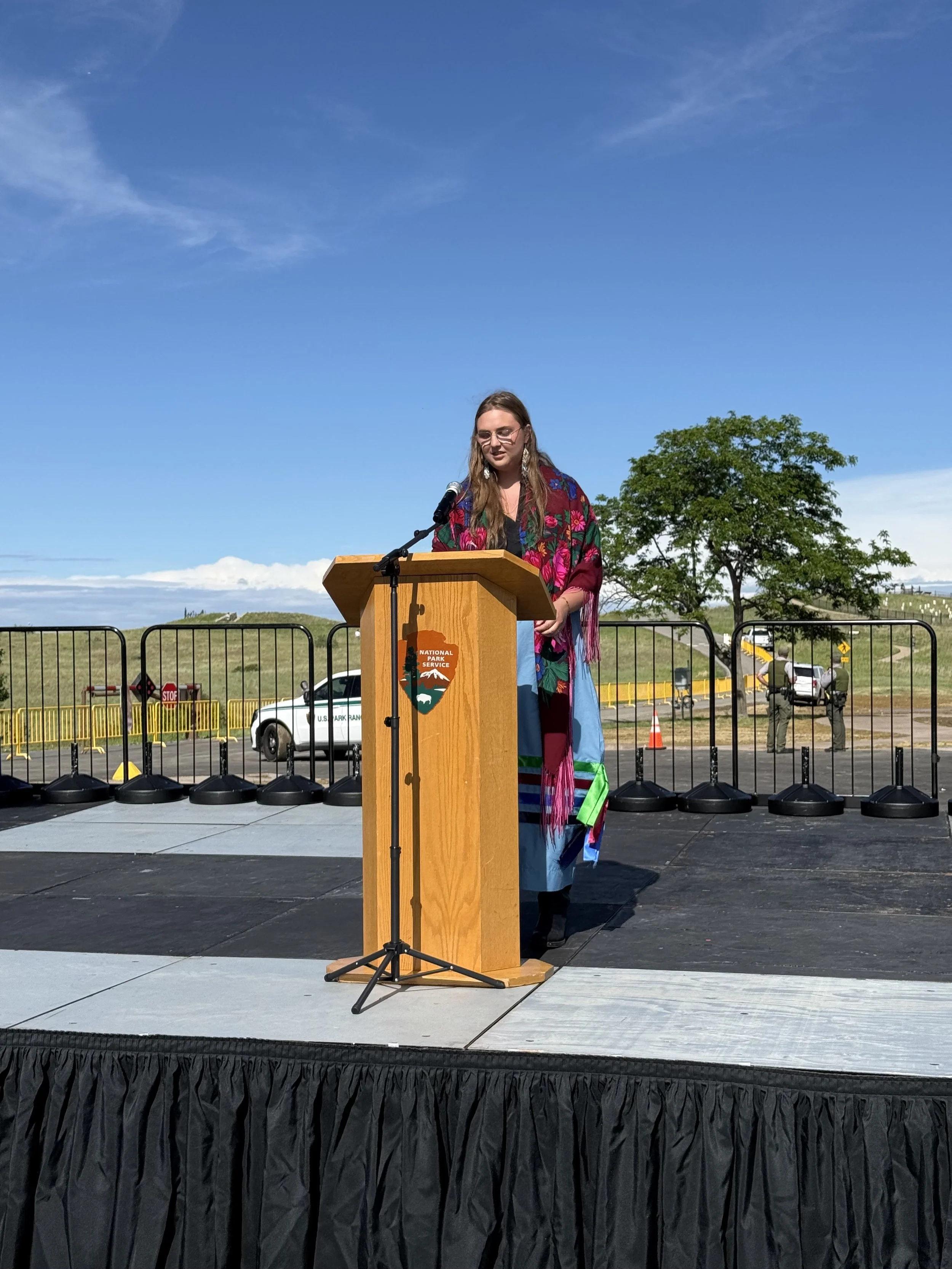
150th Anniversary of Little Bighorn Speech
3:40PM
June 25, 2026
Good afternoon my relatives,
I greet you with a good heart today on the 150th anniversary of the Battle of Little Bighorn.
I want to begin by thanking the Elders who have been lifting us up in prayer and began this morning in a good way. I also want to thank Chairman Whiteclay and Chairman LeBeau for their opening remarks this afternoon and their significant efforts for this anniversary. I also want to acknowledge all of the important elected leadership here today.
My name is Alyssa Dawn Schatz, I am a member of Wood Mountain Lakota First Nation and a current Masters student at Harvard University. I am a descendant of Chief Black Moon. My family line is from his granddaughter Emma Loves War-LeCaine, who was a significant Lakota matriarch within the Wood Mountain Lakota First Nation. As some of you might know, Emma had six children; Alice, John, Charles, Elizabeth, George and Walter. All of them being significant with John being our Chief Ellen LeCaine’s grandfather, Lizzy being the Matriarch of the Ogle family and her son Walter, who married Caroline and had several children including a daughter named Margaret. She was the mother to five boys including my Lala Roy Eklund. My grandfather Roy had my mother Charlene Schatz. So after Black Moon, I represent the seventh generation in this family line.
So today as a descendant of Chief Black Moon, our Matriarch Emma Loves War, the granddaughter of Roy Eklund, and the daughter of Charlene Schatz, it is my absolute pleasure to stand before you on behalf of Chief and Council of the Wood Mountain Lakota First Nation to provide greetings and to share about our community.
It is critical for me to begin by situating who I am and where I belong within my community since our kinship ties are fundamental to who we are and our connection to this territory.
Further, I also must note that I will only share about our Lakota band in Canada but there are also eight other very important Dakota Nations who are in Canada, who have their own story to share that is vitally important and deeply interconnected through relatives to our community.
Although more revered Elders and historians are telling this story today, I would like to briefly provide context on how some Lakota moved to and remained at Wood Mountain after the Battle of Little Bighorn.
As you know, the renewed dedication of resources against the Lakota after the Battle caused many people from the Lakota Oyate to move into Canada. This was already a land that they knew well and were deeply interconnected to as part of Lakota country.
Our esteemed Wood Mountain Lakota member Claire Thomson put it this way in her 2022 dissertation “part of the resistance against American colonialism and violence was traveling north to present-day Saskatchewan after 1876 and approximately 5,000 Lakota people moved with the leaders who did not want to cede land, sovereignty, horses or weapons…. They purposefully used the border to their advantage knowing that their American Pursuers could not reach them there. But this is not to define the Lakota people as refugees, but rather to center their decision making and movement within lands already known to them”
In the 1870s the Lakota at Wood Mountain were able to hunt to provide for themselves. However in 1879-1880 there was a prairie fire that stopped the bison from coming north of the border. With already dwindling bison numbers this fire and a harsh winter created excruciating conditions.
And the Government of Canada considered the Lakota at Wood Mountain as foreigners or refugees from the United States, and did not welcome them there, even though they were in their own territory.
By 1880, James Morrow Walsh, the North-West Mounted Police Superintendent for the area made a report that said “ The meat of the camp this day became exhausted and owing to the poor condition of the Indian horses, the buffalo, 70 miles distant, could not be reached and further supply could not be procured. Hunger and suffering prevailed for the next five or six weeks…. In some cases persons became so reduced as to render them unable to assist themselves, and I was forced to make small issue of food to save their lives”
This act occurred because there was trust between Walsh and Sitting Bull, Thomson writes that “Walsh and Sitting Bull had grown to trust each and even to become friends. Though their friendship helped to keep the peace and quell tensions, Walsh’s superiors were not happy with this perceived leniency. Prime Minister John A. Macdonald “began to suspect that Walsh was lukewarm in his efforts to persuade the Sioux to leave Canada, and then that the superintendent was actively working to prevent their leaving.” Walsh was transferred away from his posts … no doubt to remove him from any contact with Sitting Bull”
Further, Thomson writes “Eventually with food scarce and the winters more difficult, many Lakota people began trickling back into the U.S. to settle on reservations. Chief Sitting Bull and his one of the last large groups of Lakota people to go to the U.S. in 1881. Even in Sitting Bull’s surrender, kinship played a role, as it was remembered:
Sitting Bull had an intense love for his family. He demonstrated this by killing the warrior who killed his father and by providing for his mother until her death. In fact, he only surrendered in the end because his daughter, Many Horses, was, he thought, being held a prisoner in chains. On this point one Hunkpapa said, “You hear officers boast of conquering Sitting Bull, but the one who brought him to the post was his daughter. The love of the parent for the child is strong in my race”
So in 1881, Sitting Bull made the journey from Qu’Appelle and Willow Bunch to Fort Buford to be the last person to surrender his rifle. In his speech on July 20, 1881 Sitting Bull is recorded saying that he “left several families at Wood Mountain and between there and Qu’Appelle”.
There are slightly different estimates on the exact number of people who did not surrender, Ron Papandrea estimates about 250 people and the Indian Commissioner Edgar Dewdy in 1882 thought that there were about 600 people, other historians estimate several hundred.
Especially after 1881, the government mostly ignored the Lakota, but this is what they wanted. The Lakota at Wood Mountain were resisting after their experiences at the Battle of Little Bighorn. They wanted to be left alone and not have interference in their lives. The Government of Canada couldn’t push out the Lakota since they didn’t have the manpower or the finances to do it.
Then in the 1890s the Government of Canada began enforcing residential schools, where the model of the schools was to kill the Indian and save the child. The Lakota at Wood Mountain knew that there were high death rates and horrible conditions at these schools. However, the government mandated the enrolment of Indigenous children across the country and many families at Wood Mountain have been profoundly impacted by these schools. This has had devastating intergenerational impacts for Indigenous peoples.
The Lakota at Wood Mountain stayed on this land without a reserve until 1910, when many in the area recommended to the Department of Indian Affairs to give the Lakota a reserve, which the Government did do.
So in 1910, the Canadian government set aside an area essentially three miles by six miles or about eleven thousand acres west of the Wood Mountain mounted police post, as a temporary reserve for the Lakota.
Still in 1919 the Lakota were described by the Indian Commissioner W.M Graham as ‘American Indians’ with ‘no real claim on this country,’ despite that present day southern Saskatchewan was part of the original Lakota country. Thomson writes that “Dealing with Lakota people in Canada as “foreigners” or “American Indians” is an absurd claim since their nationhood predates the governments making these claims”
Later in the same year of 1919, the western half of the reserve was taken away from the Wood Mountain Lakota and opened to settlement for veterans of World War I. So in the end, in 1930, the reserve was made permanent at a size of about five thousand acres. This was half of the original amount set aside for Wood Mountain.
Our community today has maintained our history of resistance and worked hard to rectify these harms against our community.
In 2020, under the Trudeau Government, the Wood Mountain Lakota First Nation finalized many years of negotiations with the Government of Canada for a settlement for the permanent reservation land that was taken in 1919 for non-Indigenous World War I veterans.
Then in 2024, the Government of Canada through the Minister of Crown-Indigenous Relations issued a formal apology and statement of recognition to the Dakota Lakota in Canada. Minister Anandasangaree apologized on behalf of the Government of Canada for treating the Lakota Dakota Nations as refugees in our own land.
However, it is critical to note that this was only a statement of recognition and apology without any further action to make this right.
Today Wood Mountain is located about six hours north of Billings, Montana. We have about 430 members. We are very proud to be Lakota, and we are very glad to be represented here today on the 150th anniversary of the Battle of Little Bighorn. Thank you for letting us share our story of resistance and undeniable grit.